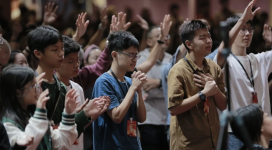
The 10th Chinese Congress on World Evangelization (10th CCOWE) officially kicked off on the evening of July 20 at the Borneo Convention Centre Kuching in Sarawak, Malaysia. Centered on the theme “Open our EAR, Understanding our ERA, Here we ARE,” the conference aims to foster a space for listening, dialogue, and renewal among Chinese churches worldwide.
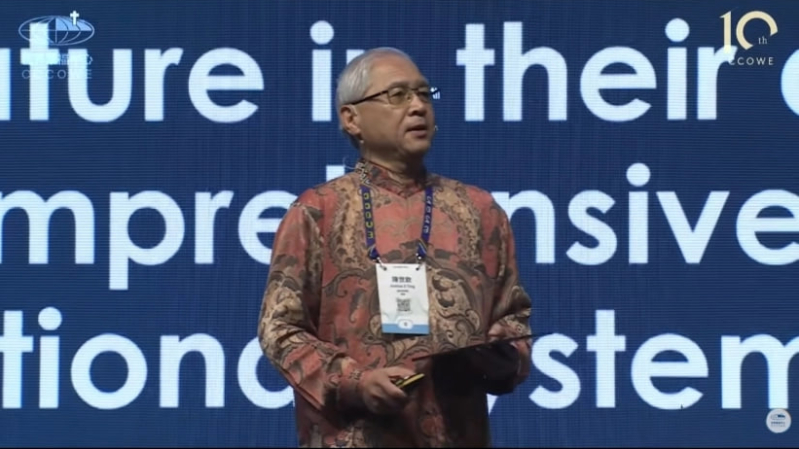
During the opening ceremony, Rev. Dr. Joshua Ting (陳世欽)—former General Secretary of the Chinese Coordination Centre of World Evangelization (CCCOWE) and current Acting President of GETS Theological Seminary—delivered a poignant exhortation. He pointed out that contemporary Chinese churches have gradually strayed from Christ's mission in their pursuit of success and institutionalization, urging leaders to begin their renewal through spiritual repentance.
Rev. Ting began by inviting attendees to humbly engage in deep self-reflection regarding the current state of the Chinese church. He noted that while many churches today appear successful in terms of attendance, administration, and finances, significant crises lie hidden beneath the surface. "Churches are gradually shifting from being centered on Christ’s mission to being centered on maintaining institutions, culture, and a sense of security," he stated.
Addressing the gathered leaders, he warned: "Timothy Keller once said, 'The greatest danger facing the church is not failure, but forgetting its purpose in the midst of success.' Today, in many instances, our churches have expanded, our administration has matured, our numbers have grown, our institutions are more complete, tithes have increased, and our finances are more stable. Yet, our prayers are diminishing, our passion for the Gospel is waning, the younger generation is steadily leaving, biblical truth and theology are becoming superficial, faith is disconnected from daily life, life is detached from mission, co-workers are increasingly exhausted, moral character is declining, and internal friction and power struggles within churches are becoming ever more pronounced."
Analyzing internal friction and power struggles, Rev. Ting explained that these issues extend beyond surface-level conflicts over language, worship styles, or congregational arrangements. The deeper cause, he argued, lies in "the reluctance to relinquish power, an unwillingness to pass the baton, a lack of trust between generations, and where the sense of security derived from culture becomes critically dominant." He stated frankly that past hurts within church history have even instilled a fear of change in many people.
Rev. Ting paid special attention to the long-standing problem of second-generation attrition in Chinese churches. He observed that while the first generation of believers in many churches remains faithful and financial health appears intact, youth and second-generation members continue to leave in droves.
He posed a series of searching questions to the leaders present: "Similarly, our Chinese churches have long faced the issue of losing the second generation. In many churches, including yours and mine, the first generation is faithful, attendance is steady, and finances look quite healthy—yet youth and second-generation members continue to leave. This points to a deeper question: Is our faith genuine? Is there transparency, candor, trust, and active listening? Can the church culture accommodate the next generation? Are there role models in this generation? Is there acceptance? Is there empowerment? Are we truly making disciples? More importantly, are we giving them room to participate and take over leadership?"
Rev. Ting summarized that the surface-level problems facing churches today ultimately stem from several core roots: youth attrition arises from a lack of discipleship and church culture; co-worker burnout stems from a loss of spiritual life and mission; internal struggles arise from issues of power succession and spiritual maturity; and church stagnation results from losing passion for the Gospel mission.
To overcome these challenges, Rev. Chan emphasized that church renewal cannot rely merely on changing systems or adopting new methods. Citing theologians John Stott and J. I. Packer, he pointed out that the church exists for God’s mission in the world, and that the essence of revival is the Holy Spirit bringing the church back into the presence of God.
He offered an earnest appeal: "More often than not, you and I do not lack awareness of the problems; rather, we are unwilling and reluctant to pay the price to change. Unwilling to confront our pride. Unwilling to surrender our desire for control. Unwilling to return to the cross. Therefore, the most difficult reform is never about institutions, but about your heart and mine. Today, if the Chinese church is to experience true renewal, the first step is not with methods, but with people; it is not about changing the external, but changing the internal—beginning with the renewal of spiritual repentance."
In closing his exhortation, Rev. Ting prayed that God would help every participant rebuild a disciple-making life rather than simply organizing programs or activities. He stressed that churches should genuinely cultivate followers of Jesus Christ rather than merely providing meetings and services. He expressed his hope that churches would return to a holy fear of God, commitment to Christ, obedience to the Holy Spirit, loyalty to the truth, and love for lost souls.
"As the CCOWE movement enters its second 50 years, may the Chinese church—starting with us as leaders—live out the truth, take up the cross, embrace the mission, and stand as a witness in this generation," he concluded.